
Monograph / Signals of progress
Drilling Through the Baseload Bottleneck
From underground heat to dependable power.
Enhanced geothermal systems promise firm power in more places; the case depends on reservoir performance, net delivery and accountable risk management
By Evelyna Bellamy · Editorial analysis; not externally peer reviewed. 1147 words. Estimated at 200 words per minute for the abstract and main prose; references and interactive studies take additional time. Numerical dignity assessments are withheld pending source review. Publication details revised 2026-10-10.
The attraction of geothermal power begins with heat that does not wait for sunlight or a favourable wind. The hard part is turning that resource into dependable electricity at a particular site. Enhanced geothermal systems expand the engineering possibilities, and the overlap with oilfield tools gives the story a concrete industrial foundation. But an underground resource is not yet an operating plant. The most useful case for this technology follows the steps between those two things, rather than promising clean power anywhere from a successful test.
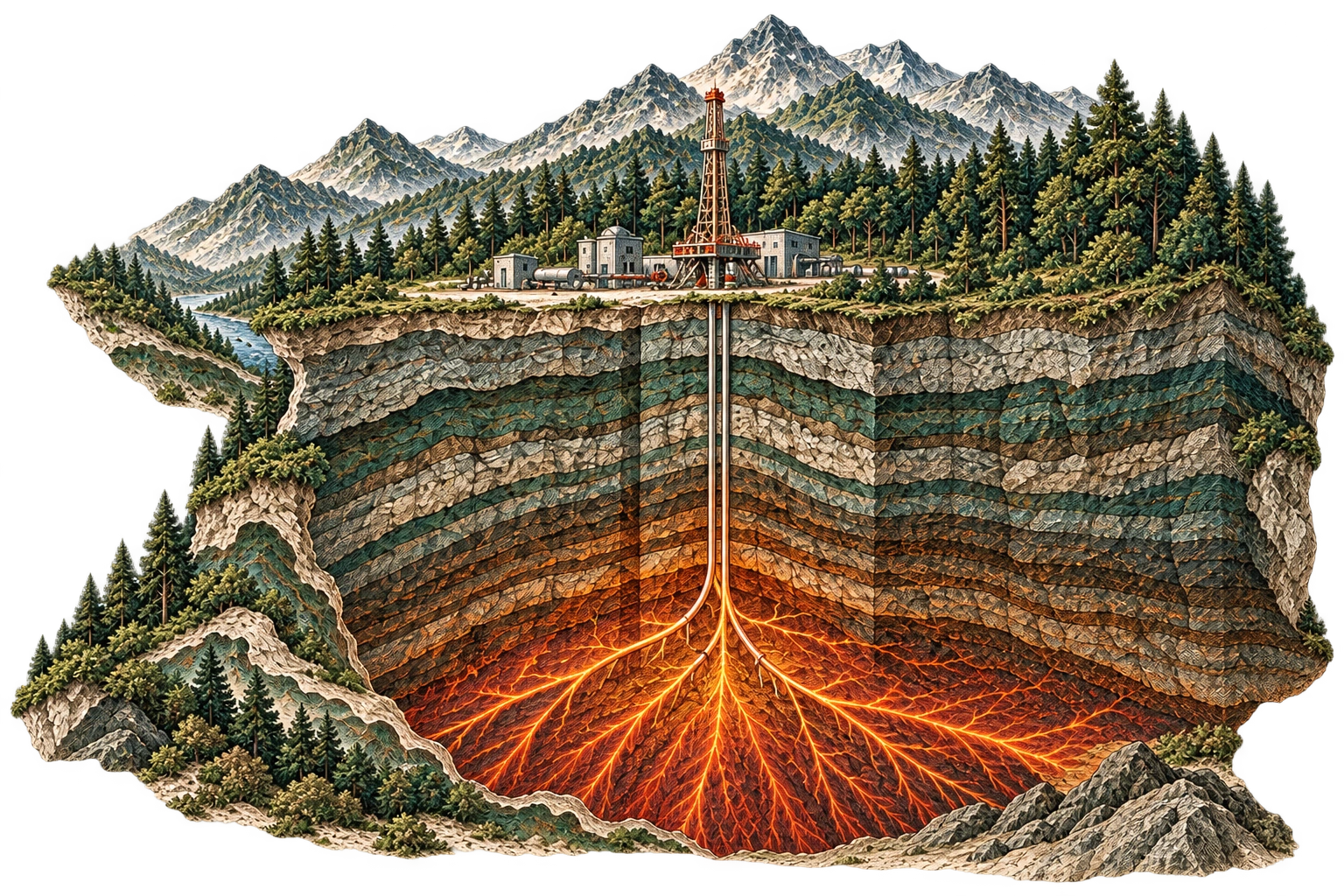
DOE’s geothermal explainer distinguishes the mechanisms. Natural hydrothermal power needs heat, fluid and permeability. Fracture-based EGS creates or reopens pathways so fluid can circulate through hot rock. Closed-loop geothermal instead circulates working fluid through sealed underground pipes without relying on a fracture network. Calling a fractured reservoir a completed closed-loop system confuses these technologies. Recirculation at the surface does not settle how heat is collected underground, and the distinction matters when discussing project performance and risk.
A field test has a time boundary
Fervo’s July 18, 2023 Project Red announcement reports a 30-day well test in northern Nevada, with a flow rate of 63 litres per second and a production temperature of 191°C. The company says the result enables 3.5 MW of electrical production. These are developer-reported test results. They do not supply an annual commercial generation record, establish a capacity factor above 95 percent or demonstrate uninterrupted output for the life of the reservoir. The test is meaningful evidence of a particular configuration, with a particular observation period.
My judgment is that promising demonstrations deserve a more demanding next chapter. A buyer needs to know what the complete plant delivers, how that output changes over time and what operating conditions support it. A local community needs to know which effects will be monitored and who is responsible when assumptions fail. A short test can motivate those questions and justify further investigation. Expanding its duration or geographical reach in prose makes the claim less useful precisely when the technology needs credible follow-through.
Resource availability and delivered service also answer different questions. Heat beneath a site may be available when variable generation falls, while an individual plant can still need maintenance or consume some of its own production. Whether a geothermal project can meet a buyer’s needs therefore requires an operating record and contract details. This essay does not infer that all battery applications fail beyond four to eight hours, or that one generation technology eliminates the need to compare complete systems.
Count the electricity that reaches the grid
Consider a constructed plant with 10 MW of gross output while running. Suppose pumping and other internal loads use 1 MW, leaving 9 MW available to the grid. Assume it operates at those fixed levels for 90 percent of a 365-day year, with zero output for the rest. A year contains 8,760 hours, so the delivered energy is 9 multiplied by 8,760 multiplied by 0.90: 70,956 MWh. Every input is invented for this example; none is a measurement of Project Red or a forecast for another site.
At the same assumed operating hours, gross generation would be 78,840 MWh. The 7,884 MWh difference is the model’s internal consumption. A headline that reports gross capacity alone cannot answer the buyer’s annual-energy question. Nor does the calculation establish the plant’s costs, its ability to follow changing demand or the persistence of reservoir performance. It simply makes the accounting boundary visible. A real comparison should name that boundary and use observed or explicitly modelled inputs.
Firm power becomes a public benefit through electricity delivered and responsibilities kept.
The longer record should distinguish reservoir behaviour from plant operation. Flow and temperature observations, power consumption, outages and actual net exports would let an outside reviewer see where performance changes occurred. That is my proposed evidence standard, not a claim that every developer publishes such a complete dataset. Commercial confidentiality can limit disclosure, but a buyer or regulator still needs a credible way to assess the obligations it is accepting. A promise of annual reliability needs annual evidence, not a test relabelled as a year.
Risk management continues after the intervention
DOE’s January 2012 induced-seismicity protocol offers guidance for EGS screening, monitoring, communication and mitigation tailored to a project. It discusses operational responses to seismic activity and cautions that activity can continue after injection stops. This is an important limit on any claim that an automatic shutdown makes risk disappear. The protocol is dated guidance, not a universal permit or a finding that a particular current project is safe. It does not provide a single threshold that this essay can responsibly prescribe for all reservoirs.
The institutional task is to make that project-specific approach usable. I would look for a named monitoring owner, clearly communicated escalation arrangements and an account of how affected people can raise concerns. Those are recommendations, not descriptions of every operating project. The complication is that uncertainty cannot be removed simply by assigning responsibility. Monitoring can reveal changing conditions, and an intervention can require continuing observation. A credible public account should explain those limits alongside the response arrangements.
Connection to the electricity system is another distinct dependency. FERC’s July 27, 2023 fact sheet identifies Order No. 2023 under docket RM22-14 and describes reforms to generator interconnection procedures, including cluster studies and readiness requirements. It does not guarantee a geothermal project’s energization or resolve every land, water or permitting question. The inherited RM21-17 docket was misidentified and is withdrawn. A general reference to power law cannot replace the actual connection process and permissions relevant to a site.
Industrial continuity needs a labor record
DOE’s explainer identifies overlaps between geothermal and oil-and-gas knowledge, drilling and well construction through its GEODE initiative. That is a reason to examine skill transfer; it is not a measured employment transition. The useful follow-up would identify who was hired, which skills transferred, what additional training was needed and what wages and working conditions resulted. An invented drilling-crew scene cannot supply that evidence, and a technical similarity does not establish a direct route to unionized work.
The public case also needs a comparison with stated boundaries. Claims of zero emissions or a surface footprint below one percent of competing technologies require definitions, project data and comparable denominators. This review does not establish those figures, so it withdraws them. That withdrawal leaves the central possibility intact: a project that can deliver useful firm electricity in a suitable location may widen the choices available to a grid. Its environmental and distributional value should be demonstrated through the relevant measurements.
Drilling through the baseload bottleneck is therefore a proposal to build and verify another dependable option. The engineering promise is substantial enough to deserve accurate names and patient evidence. The human promise depends on more: reliable net delivery, workable oversight and employment claims that can be followed into actual jobs. A successful field test can begin that argument. A continuing record of performance and responsibility is what would let a community decide how much confidence to place in it.
- →Fracture-based EGS and sealed-pipe closed-loop geothermal are different technologies. Recirculating water does not make their underground mechanisms identical.
- →Fervo’s July 2023 Project Red announcement reports a 30-day well test. It does not establish an annual capacity factor above 95 percent or uninterrupted lifetime output.
- →The gross-to-net generation example is constructed. Delivered electricity must account for plant consumption and downtime; a test result is not an annual production record.
- →DOE’s 2012 seismicity protocol is project-specific guidance; FERC’s 2023 interconnection reforms concern generator procedures. Neither supplies blanket permission or a guarantee of energization.
Cited sources and limits (4)
U.S. Department of Energy (n.d.). Enhanced Geothermal Systems. https://www.energy.gov/hgeo/geothermal/enhanced-geothermal-systems
governmentFervo Energy (2023). Fervo Energy Announces Technology Breakthrough in Next-Generation Geothermal (July 18). https://fervoenergy.com/fervo-energy-announces-technology-breakthrough-in-next-generation-geothermal/
primaryMajer, E., Nelson, J., Robertson-Tait, A., Savy, J., & Wong, I. (2012). Protocol for Addressing Induced Seismicity Associated with Enhanced Geothermal Systems (DOE/EE-0662). U.S. Department of Energy. https://www1.eere.energy.gov/geothermal/pdfs/geothermal_seismicity_protocol_012012.pdf
governmentFederal Energy Regulatory Commission (2023). Fact Sheet: Improvements to Generator Interconnection Procedures and Agreements (July 27; Order No. 2023, RM22-14). https://ferc.gov/news-events/news/fact-sheet-improvements-generator-interconnection-procedures-and-agreements
government
Landscape and survey plates are illustrative, not measured geography. Artwork provenance ↗