
Monograph / Quiet Excellence
The Other Transformer Bottleneck
The physical machinery behind the promise.
Long equipment lead times expose the difference between financing a data center and delivering an electrical system that can serve it
By Evelyna Bellamy · Editorial analysis; not externally peer reviewed. 1149 words. Estimated at 200 words per minute for the abstract and main prose; references and interactive studies take additional time. Numerical dignity assessments are withheld pending source review. Publication details revised 2026-10-10.
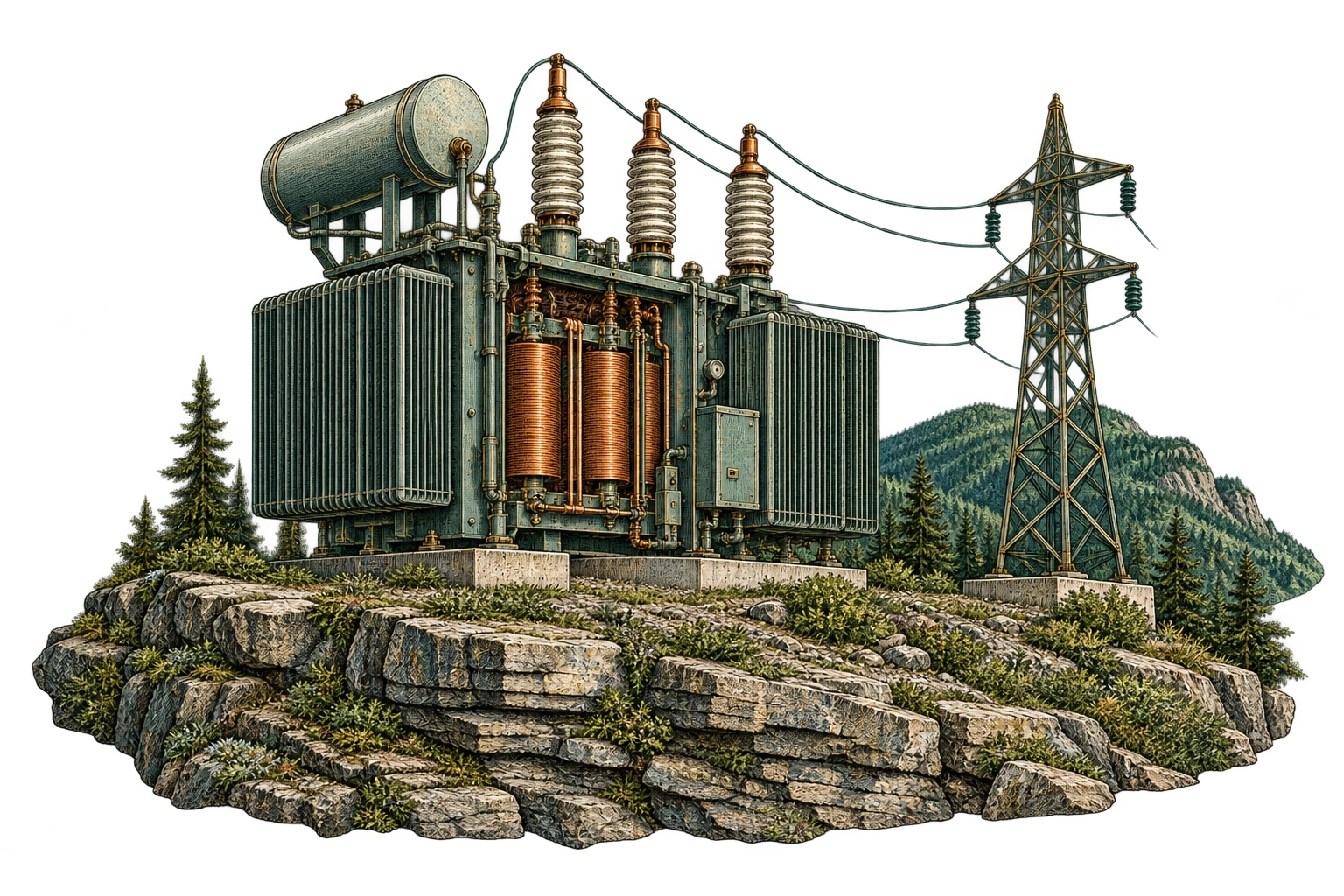
A data center can have investors, servers and a building before it has usable electrical service. The gap is easy to obscure because each contract looks like progress. An equipment order is real; so is the remaining work needed to connect, test and operate it. Transformers make that gap visible. They are a consequential part of the infrastructure behind computing, but calling them the single bottleneck everywhere replaces a project question with a slogan. The useful question is which dependency determines when a particular service can begin.
The Department of Energy’s July 2024 report to Congress describes large power transformer procurement as a process spanning specification, bidding, manufacturing, testing and delivery. Its producer interviews report lead times reaching or exceeding 36 months. The report also gives a historical import picture: more than 80 percent of roughly 750 new US transformers above 60 MVA in 2019 were imported. These are bounded observations about a class of equipment and dated evidence. They are not a current quotation for every buyer, or the import share of every transformer in use.
First identify the equipment
DOE’s March 5, 2026 distribution-transformer webinar reports that distribution lead times rose from three to six months in 2019 to one to two years or longer in 2024, which it identifies as the latest available data. A distribution transformer and a large power transformer belong to different procurement discussions. Combining those observations into a universal three-to-five-year wait loses the equipment class and observation date. A campus-specific claim needs its requested ratings, supplier commitment and delivery scope alongside the number.
That discipline also changes how national demand forecasts enter the story. Berkeley Lab’s June 2026 institutional abstract for its 2025 Update projects data centers using 11.8 percent of US electricity in 2030 in its reference case, with a range of 9.5 to 15.3 percent across scenarios. These are modelled futures, not observed 2030 consumption. The abstract describes assumptions about equipment shipments and operation. This review checked that abstract and publication metadata, not a full reproduction of the underlying model. National demand growth alone cannot identify the limiting component at one site.
My judgment is that the strongest infrastructure argument starts smaller. A developer should be able to explain which pieces of its announced capacity have credible service dates, and which remain contingent. A utility should be able to distinguish an application, an executed agreement and operational service when communicating with customers. Those are proposed disclosure standards. Without them, an impressive aggregate can combine projects at very different stages, leaving a resident or investor unable to tell what has actually become possible.
The longest dependency can move
Consider a constructed schedule in which four independent workstreams start together. Servers will be ready in 12 months, civil works in 18, a transformer delivered and commissioned in 30, and electrical service approval completed in 36. Assume those milestones include everything each workstream needs and operation requires all four. The earliest opening is month 36. These are invented durations, deliberately simplified to show the comparison; they are not a quotation, an interconnection forecast or a description of an actual campus.
Shortening transformer readiness to month 24 would leave opening at month 36 because approval still finishes last. Shortening approval instead to month 20, while keeping the original transformer milestone at 30, would move opening to month 30. The equipment can be expensive and slow without controlling the current schedule. Conversely, removing another delay can make it decisive. This is why a claim about the binding constraint needs the whole dependency map and should be revisited as milestones change.
Money can secure an order; usable service requires the remaining dependencies to finish.
Real schedules are more complicated than the example. Design choices can depend on a utility study; equipment changes can require revised protection arrangements; construction and commissioning may be sequential rather than parallel. The example therefore supplies a reasoning method, not a ready-made plan. A credible project account would show those dependencies, state what each date includes and distinguish supplier estimates from completed milestones. It would also explain what happens if expected demand arrives later or in a different form.
An announcement is a future dependency
Hitachi Energy’s September 15, 2026 announcement gives a concrete manufacturing timeline. It describes a planned $528 million transformer factory in Gallman, Mississippi, with production scheduled to begin in 2029. That is a manufacturer’s investment announcement and target date. It is not evidence that the new output is already available, that every prospective buyer has a slot, or that the schedule is guaranteed. Reporting it as present relief would erase the interval the announcement itself specifies.
DOE’s August 10, 2026 supply-chain announcement likewise describes a planned programme of up to $375 million, including standardisation, refurbishment and reuse, and next-generation power electronics. Its anticipated benefits are forward-looking. This essay does not treat the programme as measured delivery improvement or assume that a solid-state device can replace any large transformer in an existing design. The relevant question for a buyer remains whether a proposed intervention meets its actual electrical requirements on an evidenced schedule.
Manufacturing investment can still matter before its output arrives. It gives planners something concrete to examine: a location, a proposed production date and a supplier responsible for delivery. The public should be able to follow the transition from announcement to operating capacity. That transition also needs a labor record. Employment claims become more useful when they identify filled positions, wages, training routes and retention. Neither an equipment shortage nor a factory announcement proves that the resulting jobs are unionized, accessible without a degree or durable.
The grid dividend has conditions
The public-benefit question begins with the service arrangement. Who pays for the dedicated equipment? Which assets can serve other customers? What commitments survive if the anchor customer reduces its planned load? Who maintains them? These are questions to put to an actual agreement and the applicable regulatory record, not conclusions this essay can settle through a generic reference to federal power law. A purchased transformer can support a private project without automatically becoming a broadly shared improvement.
There is a further complication: faster delivery and better public service are different outcomes. A project can meet its opening date while leaving costs, maintenance responsibilities or reliability effects unclear to other customers. My proposed test of a public dividend is therefore evidence of usable shared capacity, a transparent allocation of obligations and a continuing operating record. It would be premature to assign a numerical dignity score from demand forecasts and investment announcements alone.
The other transformer bottleneck is ultimately a problem of accountable delivery. Hardware lead times deserve attention because they can change what a computing investment can do and when. They deserve precision for the same reason. Equipment class, dated evidence and an actual dependency map make the argument stronger than an assertion that physical scarcity has permanently replaced financial constraint. The human stake is a community able to see what a project promises, what it has secured and what responsibilities remain when the promised service arrives.
- →Transformer lead times depend on equipment class and procurement scope. Dated estimates do not establish one universal delivery delay for all data centers.
- →Berkeley Lab’s June 2026 update projects a range of US data-center electricity demand for 2030; a national forecast does not identify the limiting component at a particular site.
- →Hitachi’s September 2026 Mississippi factory announcement schedules production for 2029. Announced investment is not capacity already available to buyers.
- →The critical-path example is constructed. Employment quality, cost allocation and a public grid dividend require evidence beyond an equipment order.
Cited sources and limits (5)
U.S. Department of Energy (2024). Large Power Transformer Resilience: Report to Congress. https://www.energy.gov/sites/default/files/2024-10/EXEC-2022-001242%20-%20Large%20Power%20Transformer%20Resilience%20Report%20signed%20by%20Secretary%20Granholm%20on%207-10-24.pdf
governmentU.S. Department of Energy (2026). Distribution Transformer Webinar: Text Alternative (March 5). https://www.energy.gov/oe/distribution-transformer-webinar-text-alternative
governmentSmith, S. J., Hubbard, A., Newkirk, A., Ganeshalingam, M., Holecek, B., Sartor, D. A., Mills, M., & Shehabi, A. (2026). United States Data Center Energy Usage Report: 2025 Update. Lawrence Berkeley National Laboratory. https://eta-publications.lbl.gov/publications/united-states-data-center-energy-2025
primaryHitachi Energy (2026). Hitachi deepens commitment to U.S. manufacturing with $528 million Mississippi transformer factory (September 15). https://www.hitachienergy.com/pl/pl/news-and-events/press-releases/2026/09/hitachi-deepens-commitment-to-u-s-manufacturing-with-528-million-mississippi-transformer-factory
primaryU.S. Department of Energy (2026). Strengthening America’s Grid Supply Chain (August 10). https://www.energy.gov/oe/articles/strengthening-americas-grid-supply-chain
government
Landscape and survey plates are illustrative, not measured geography. Artwork provenance ↗